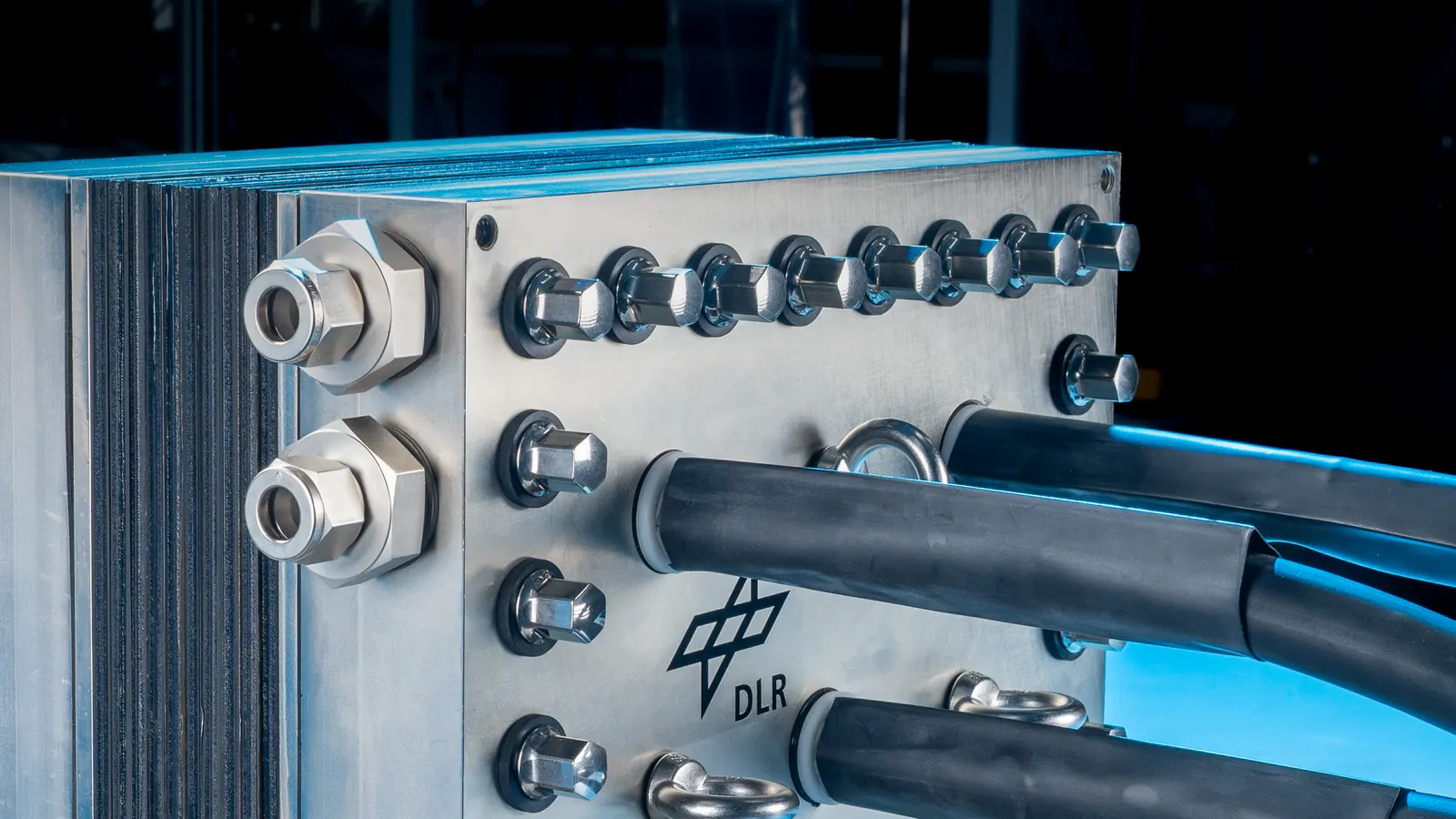
Every hydrogen researcher knows the gap between a prototype that works in an institute lab and a product a customer can order, install and service. In July 2026, the German Aerospace Center (DLR) described one way that gap is being closed. In a post from DLR Innovation & Transfer, DLR announced that CENmat has acquired the licence for the design of a prototype developed at DLR, and that CENmat will now bring it to market maturity.
This article explains what that means, where it comes from, and what it changes for customers.
Where we come from
We were founded as a spin-off from the DLR Institute of Engineering Thermodynamics in Stuttgart. In DLR's words, CENmat "develops electrolysers and their components for industry", and we continue to work closely with DLR teams.
That link has never been a formality. Our catalysts, membranes and electrodes have been measured, benchmarked and stress-tested at DLR for years in joint EU projects: in NEWELY and PROMET-H2, and today in HYScale and REDHy. DLR's electrochemistry teams bring deep cell and stack engineering. We bring materials, components and the commercial drive to turn them into products. In June 2026, we were also one of 14 DLR start-up teams presenting to investors at DLR's Investor Day.
The HYScale context
DLR's post places the licence in the context of the HYScale consortium. There, DLR works with industry and research partners on new high-performance materials for electrolysers, with three goals: more energy-efficient hydrogen production, lower-cost electrolysers, and replacements for the "forever chemicals" (PFAS) that do not break down in nature.
We coordinate HYScale. Its public milestones show how a design moves towards a product:
- Materials at scale. We upscaled our PFAS-free AionFLX™ membranes and CRM-free electrodes to stack formats. We describe the membrane side here.
- A validated short stack. A 6 kW short stack built by research partner CNR-ITAE, with 400 cm² cells, ran stably across temperatures and current densities.
- A 100 kW design. In September 2025, DLR finalised the digital design of the 100 kW HYScale stack.
- Production. In May 2026, HYScale announced that production was underway. It has since been completed, and the 100 kW system is now in commissioning. Read the full stack story.
Why licensing matters
Research institutes are very good at designing prototypes that prove a concept. They are not set up to manufacture, certify, sell and service products for decades. Companies are. A licence formally transfers the right to use a design commercially, so knowledge built up with public funding reaches the market instead of staying in a report.
DLR summed it up well: consortia do not only pool know-how and skills, they also "pave the way from research results to application", as the licensing between CENmat and DLR shows.
For us, it completes a picture we have been building for several years. We are no longer just a materials supplier. We work on AEM and PEM electrolysis, from materials to stacks and systems:
- Materials: AionFLX™ and AionFLX™ Plus membranes and ionomers; CRM-free OXYGN™ and H2GN™ AEM electrodes; the OXYGN-M™ ultra-low iridium PEM catalyst.
- Stacks: HYScale AEM stacks, from the 6 kW design validated at 400 cm² to the 100 kW system with cells of about 900 cm² active area.
- Systems: integration with partners for pilot and commercial projects.
What it means for customers
If you are evaluating electrolysers, three things follow:
- One partner from materials to stack. When materials and stack design come from the same team, qualification is simpler and problems are easier to trace.
- Designs with a research track record. The design comes out of years of public, peer-reviewed work, not a black box.
- A clear route to scale. The licence gives us the right to industrialise the design, so we can plan capacity and service commitments.
What's next
Our priority now is commissioning and validating the 100 kW HYScale system, then turning the design into a product that customers can order. If you are planning a pilot or want to discuss stack formats, get in touch or see the HYScale AEM stack page.
For investors: if you invest in hydrogen, electrolysis or climate technology, see what we are building and how to get in touch.
Funded by the European Union. HYScale has received funding from the Clean Hydrogen Partnership and its members under grant agreement No 101112055. Views and opinions expressed are those of the author(s) only and do not necessarily reflect those of the European Union or the Clean Hydrogen Partnership.