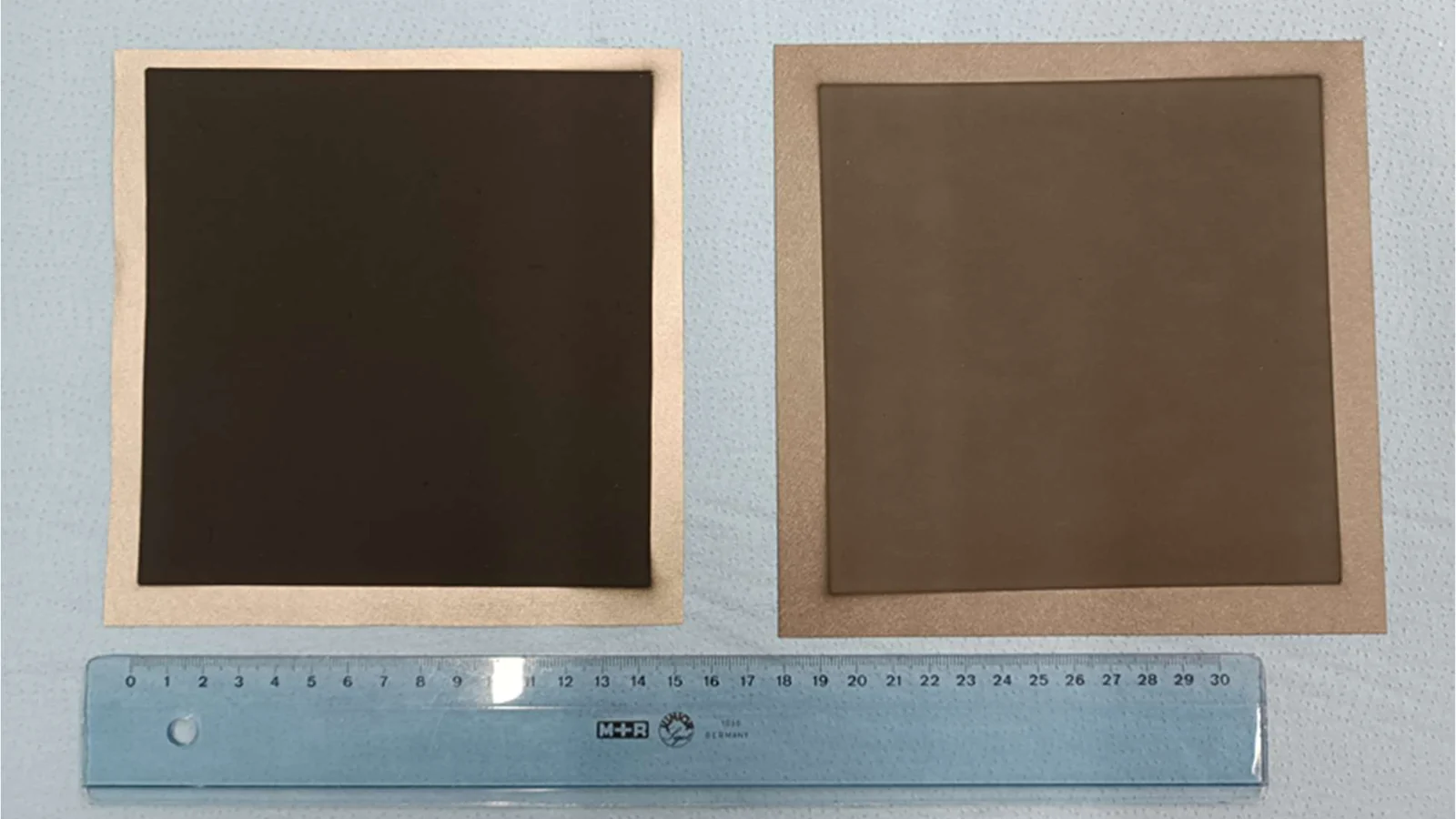
Anyone building an AEM electrolyser has to decide early where the catalyst goes. It can be coated onto the membrane, making a catalyst-coated membrane (CCM), the standard in PEM. Or it can be coated onto the porous transport layer, making a catalyst-coated electrode, usually called CCS, that is pressed against a bare membrane. The EU project NEWELY (2020–2023, coordinated by DLR, with us supplying the catalysts) tried both. Its public reports are a useful, frank record of why the project ended up on CCS.
Read the deliverables: D3.10 "MEA production" · D1.10 "Final report" · NEWELY results on CORDIS
The CCM attempt
PEM experience says CCMs give the best contact between catalyst and membrane, so NEWELY's partners tried several ways to make them: direct spraying, doctor-blade and bar coating, and decal transfer. Spraying straight onto an AEM caused severe delamination once the membrane was activated in KOH, because AEMs swell and change shape far more than PEM membranes. Decal transfer with a gentle hot-press step worked mechanically, yet the resulting CCMs stayed well below target, both in pure water and in 0.1 M KOH.
The lesson generalises. The swelling that helps AEMs conduct also makes it hard to keep a catalyst layer bonded to them. That is why the final report says the project's focus moved to CCS electrodes operated in very dilute (0.1 M) KOH.
The CCS route
The CCS electrodes used our PGM-free, CRM-free catalysts, the NEWELY-era grades of today's OXYGN™ anode and H2GN™ cathode lines. They were bound with the PFAS-free ionomer developed in the project and spray-coated at CEA and DLR. The public results:
- Project milestone reached. Cell voltage fell below 2 V at 1 A/cm² in 0.1 M KOH at 50 °C, with MEAs containing no PGMs.
- Full NEWELY MEA. With the project's own membrane, ionomer and our catalysts, a 25 cm² cell reached 1.5 A/cm² at 2 V (0.1 M KOH, 50 °C).
- Catalyst activity. At the project's final public event (EMEA Workshop, June 2023), we reported overpotentials of 215 mV for oxygen evolution and 116 mV for hydrogen evolution at 10 mA/cm² for our CRM-free catalysts, 1.5 A/cm² at 2 V in a single cell with spray-coated CCS electrodes, and electrodes upscaled to 200 cm² for the stack.
- Catalyst potential. In our own test cell with commercial membrane, ionomer and transport layers, the catalysts reached 1.85 V at 2 A/cm² in 0.1 M KOH.
- Durability. Long-term tests ran for 780 hours in a 2 cm² cell and 368 hours in a 25 cm² cell. The 25 cm² test averaged 28 µV/h and stopped only because the test station failed.
Pure-water operation, the original ambition, was not achieved: early cells managed only tens of mA/cm² at 2 V. The reports say so plainly, and it shaped the dilute-KOH strategy that HYScale later adopted.
Scaling the coating: 25 to 200 cm²
The MEA production report also covers practical manufacturing detail. At DLR, electrodes were built up with an automated ultrasonic spray coater in more than a hundred passes, alternating the spray direction for uniformity. Some findings:
- Ink stability matters at scale. One ink formulation settled during the long spray runs that large electrodes need; another stayed stable. Short lab runs never reveal the problem.
- Overspray is expensive. Roughly three times more catalyst went into the ink than ended up on the electrode, about 60 % loss. That argues for coating methods with better material yield as volumes grow.
- Scale-up worked. After qualification at 25 cm², six anodes and six cathodes of 200 cm² were made with the same parameters for the project's 5-cell high-pressure stack.
From NEWELY to today
NEWELY is where our CCS approach took shape. Since then, our OXYGN™ and H2GN™ electrodes have moved to 400 cm² formats in HYScale, where an independent DLR test reached 2 A/cm² at about 2 V in 0.1 M KOH (described in our D3.1 article), and they now go into a validated 6 kW short stack and the HYScale 100 kW system.
Choosing between CCS and CCM for an AEM stack? Our AEM qualification pack includes a recommended test protocol and a spec summary. Ready-to-assemble electrodes are on the OXYGN™ and H2GN™ product pages.
NEWELY received funding from the Fuel Cells and Hydrogen 2 Joint Undertaking under grant agreement No 875118.