Anion exchange membrane (AEM) electrolysis has a simple pitch: the cheap, abundant materials of alkaline electrolysis with the compact, responsive design of PEM. What it has lacked is proof at scale. Plenty of small cells hit good numbers. Far fewer projects show those numbers survive the move to large electrodes, multi-cell stacks and a system someone could buy.
That move is the whole point of HYScale, an EU project funded by the Clean Hydrogen Partnership that we coordinate. Here is where the HYScale AEM electrolyser stack stands in autumn 2026, and what we learned on the way.
The design brief
HYScale set out to build an AEM stack that is:
- Free of critical raw materials in catalysts and cell components
- PFAS-free: no fluorinated membranes or ionomers
- Efficient at high current density: target 2 A/cm² at 2 V per cell
- Low-CAPEX: target below €400 per kW at system level
- Scalable: an architecture that can grow to 0.5–1 MW
It also has to run at moderate temperature with very dilute electrolyte, which simplifies the balance of plant and reduces corrosion.
Step 1: large electrodes that behave like small ones
Every scale-up starts with materials. Our CRM-free OXYGN™ anode and H2GN™ cathode electrodes have been scaled to 400 cm² active area. Our PFAS-free AionFLX™ membrane, made from the same polymer family as its ionomer, is validated in sheets up to 900 cm², and membrane production has reached batch volumes large enough for a 100 kW stack.
Small cells set the baseline. In an independent test at DLR under the EU harmonised protocol, a 4 cm² cell with AionFLX™ and our electrodes reached 2.01 A/cm² at 2.01 V in 0.1 M KOH at 50 °C, then ran for 330 hours at under 5 µV/h. On a large, flow-field-free single cell at CNR-ITAE, our electrodes with AionFLX™ ionomer reached 2 A/cm² at 2.07 V, with Faradaic efficiency above 98 %. Both results are in the project's public deliverable D3.1, which we walk through in a separate article.
The flow-field-free design deserves a note. Machined flow fields are a big hidden cost in electrolyser stacks. Removing them, and using a square format that wastes less material when cutting components, is one of the ways HYScale attacks the €/kW target without giving up performance.
Step 2: the 6 kW short stack, validated at 400 cm²
Next came the short stack. The CNR-ITAE team designed, built and operated a 6 kW AEM short stack with HYScale membranes and electrodes at 400 cm² cell area, with short stacks of up to five cells produced. The key finding: the materials gave the same performance in the single cell and in the 6 kW stack.
The EU's own research news service reached the same conclusion. Reporting on HYScale in June 2025, CORDIS noted that large-scale applications "are now delivering results that align with those achieved in small-scale single-cell laboratory tests", and that CENmat, as coordinator, provided the catalyst-coated electrodes with CRM-free catalysts.
That sounds modest, but it is the result that matters most in scale-up. Losses from uneven compression, flow distribution and edge effects usually show up exactly here. The stack also ran stably across a wide range of temperatures and current densities, which tells us the materials combine into robust membrane electrode assemblies, not just champion lab cells.
Step 3: the 100 kW system, built and in commissioning
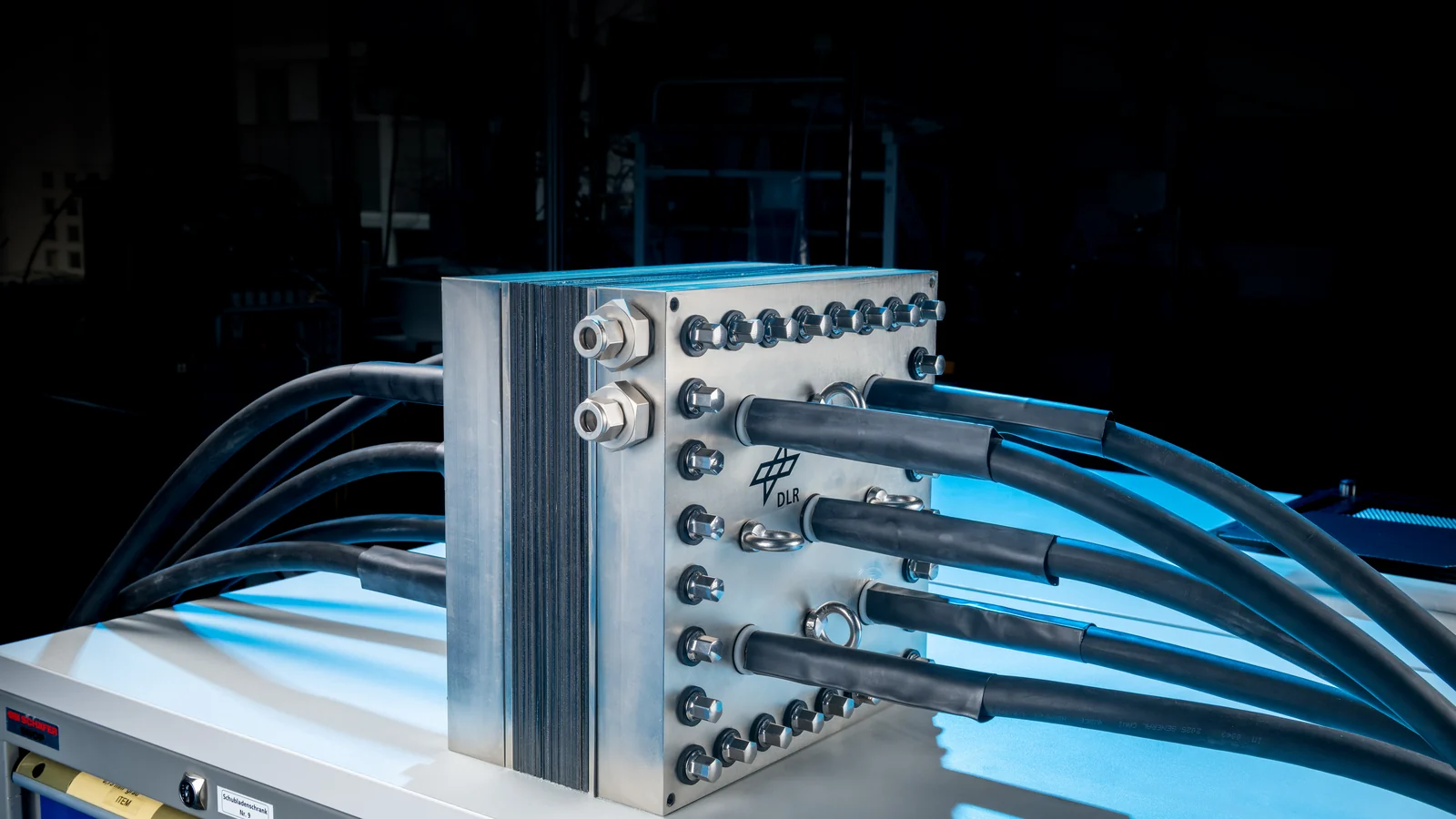
Using the short-stack data, DLR completed the design of the 100 kW HYScale stack, with cells of about 900 cm² active area. Production of the 100 kW system is completed and it is now in commissioning. Validation in an industrially relevant environment at the project's demonstration site in Greece follows.
What HYScale means for AEM buyers
For companies weighing AEM against PEM or alkaline electrolysis, HYScale answers three practical questions:
- Can AEM materials be made at stack scale? Yes. Membrane, ionomer and electrodes are produced in formats and volumes that fit a 100 kW stack.
- Does performance survive the jump from cell to stack? The 6 kW short stack says it does. The 100 kW system is the next proof point.
- Can AEM avoid iridium, other PGMs and PFAS at the same time? HYScale's materials are PGM-free, CRM-free and fluorine-free throughout.
Two parts of that story have their own articles: how we scaled AionFLX™ membrane manufacturing to stack formats, and how we licensed a DLR-developed prototype design to bring it to market.
Working with us
At CENmat, we develop AEM electrolysis from materials to stacks and systems. We supply the materials behind HYScale (AionFLX™ membranes and ionomers, OXYGN™ and H2GN™ electrodes) to stack developers and research groups, and we are developing the HYScale stack platform towards the 0.5–1 MW class. See the HYScale project page, or contact us to discuss short stacks or a paid pilot.
For investors: if you invest in hydrogen, electrolysis or climate technology, see what we are building and how to get in touch.
Funded by the European Union. HYScale has received funding from the Clean Hydrogen Partnership and its members under grant agreement No 101112055. Views and opinions expressed are those of the author(s) only and do not necessarily reflect those of the European Union or the Clean Hydrogen Partnership.