For years, the honest answer to "can I get AEM membranes for a 100 kW stack?" was "not easily". Anion exchange membranes were made in small batches, often as hand-cast films, and a large order meant months of waiting and batch-to-batch surprises. For stack developers, the membrane was the bottleneck long before the catalyst or the stack design.
In the EU project HYScale, we set out to remove that bottleneck for our AionFLX™ membrane. This article looks at what changed, what the public project record shows, and what we learned that applies to anyone buying AEM membranes at scale.
The headline result
In September 2025, HYScale announced that CENmat had upscaled both the synthesis and the casting of AionFLX™ anion exchange membranes. According to the project press release, the new process delivers two things:
- Dramatically reduced hydrogen permeability, addressing one of the long-standing performance and safety issues in AEM electrolysis.
- Batch volumes large enough for a 100 kW stack, so that membrane supply no longer limits scale-up.
"We have moved beyond laboratory production; membranes are no longer the bottleneck," said our HYScale project coordinator in the release. Trade media picked up the story, and it later appeared as a longer feature in RD Magazine co-written by researchers from CENmat, CNR and DLR.
What scale-up actually meant
Scaling a membrane is not just casting a bigger sheet. The public HYScale material describes four separate steps.
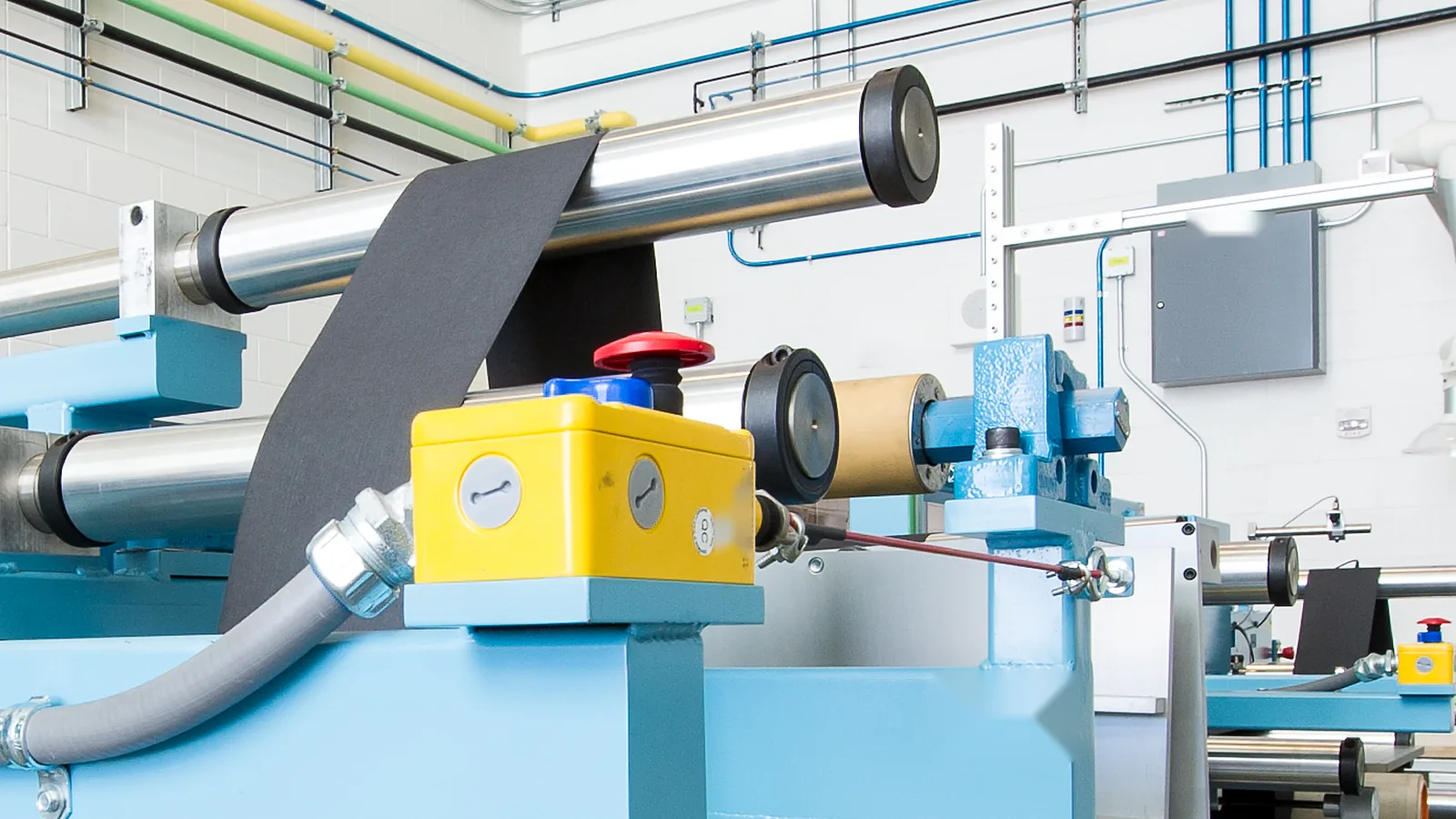
Bigger sheets, semi-automated. AionFLX™ is now cast in a semi-automated process in sheets of up to 1,000 cm², and the HYScale factsheet reports the membrane validated at 900 cm². That is the format needed for the cells of about 900 cm² in the HYScale 100 kW system, whose production is completed and which is now in commissioning.
One polymer for membrane and ionomer. The membrane and the ionomer used in the electrodes come from the same polymer batch. That shortens production time and lowers cost. It also means the membrane and the electrode binder swell and conduct in the same way, which simplifies MEA design.
Reproducibility. In a HYScale researcher interview, our project coordinator explained that upscaling brings problems you never see in the lab. Trace impurities, for example, can affect mechanical performance. High batch-to-batch reproducibility was the precondition for production volumes for 100 kW stacks and, later, megawatt-scale systems.
Lower crossover through reinforcement. The HYScale “Results in brief” on CORDIS note that membrane reinforcement reduced hydrogen crossover, enabling high current density with better safety and efficiency.
Did performance survive scale-up?
This is the question that matters, and the public record answers it at several levels:
- Single cells. The factsheet lists single-cell validation and consistent performance after scale-up.
- Short stack. In a 6 kW short stack built and operated by research partner CNR-ITAE at 400 cm² cell area, the membranes and our CRM-free electrodes ran stably across a range of temperatures and current densities.
- Independent summary. A CORDIS news article put it this way: large-scale applications "are now delivering results that align with those achieved in small-scale single-cell laboratory tests."
- Durability. The HYScale technology page reports AionFLX™ running for more than 1,000 hours in 0.1 M KOH without detectable degradation. Our reinforced grade, AionFLX™ Plus, has passed 8,000 hours in 1 M KOH, as described in our membrane durability article.
The same production know-how carries across projects. In REDHy, AionFLX™ sheets above 900 cm² became the alkaline half of a large-area PFAS-free bipolar membrane.
Five questions to ask any AEM membrane supplier
What we learned in HYScale translates into a short checklist for procurement and engineering teams:
- What is the largest sheet you produce routinely, and how? Hand-cast and semi-automated are very different supply propositions.
- Is the ionomer made from the same polymer as the membrane? If not, ask how the two are matched.
- What is your batch-to-batch spread? Ask for conductivity, thickness and mechanical data across several batches, not the best one.
- How much hydrogen crosses over, and at what load? Crossover matters most at low current density, so check it across your turndown range.
- Has the membrane been validated in a stack, not only in a 5 cm² cell? Short-stack data at realistic cell sizes is the minimum.
Next steps
AionFLX™ is produced in sheets validated at 900 cm², together with the matching AionFLX™ ionomer. See the AionFLX™ membrane page for specifications, read how the materials came together in the HYScale stack, or request samples for your own cells.
Funded by the European Union. HYScale has received funding from the Clean Hydrogen Partnership and its members under grant agreement No 101112055. Views and opinions expressed are those of the author(s) only and do not necessarily reflect those of the European Union or the Clean Hydrogen Partnership.