
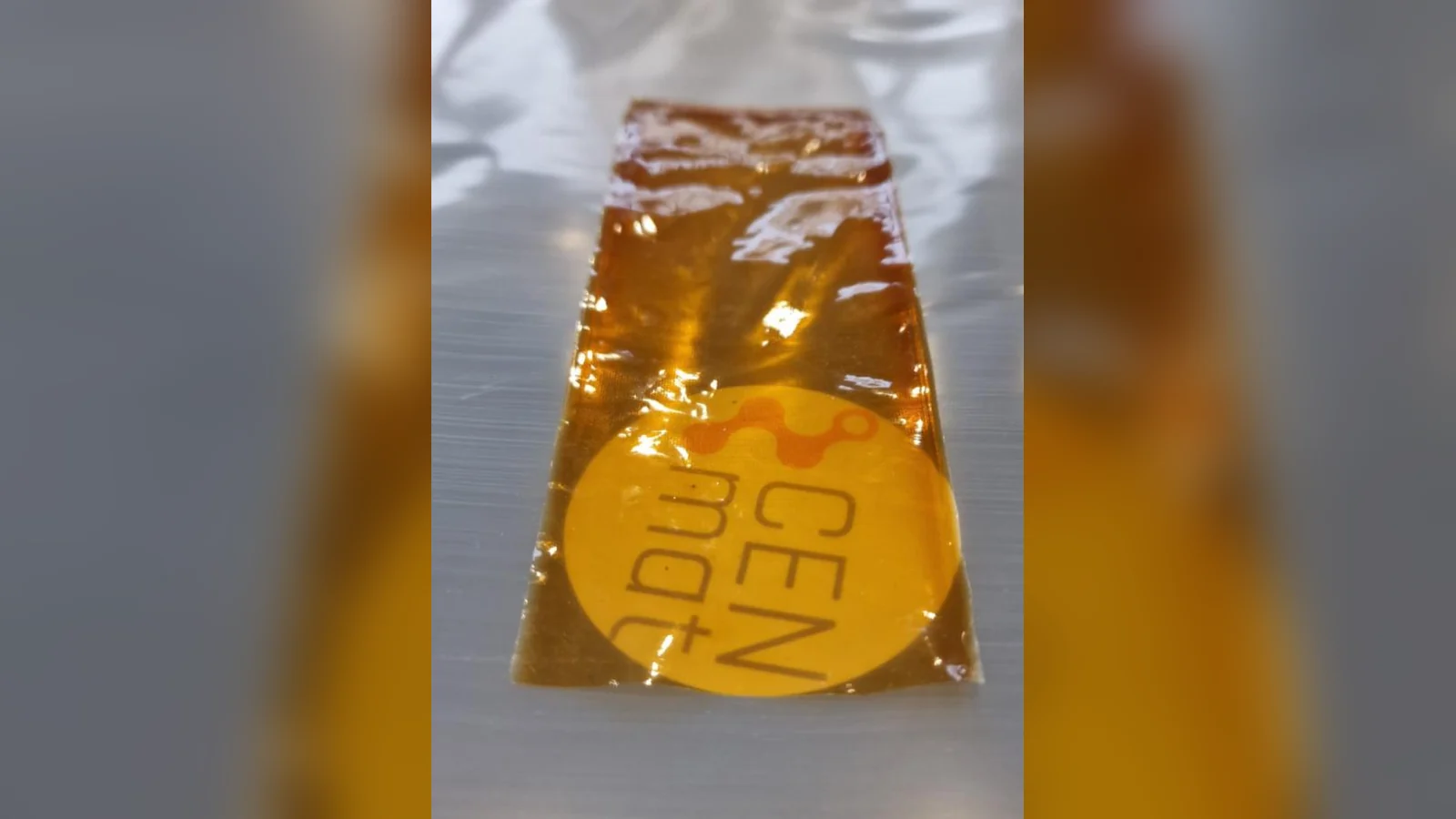
Most conversations about PFAS in electrolysers stop at the membrane: replace the fluorinated membrane and the problem is solved. In the EU project REDHy, we took on a harder version of that task. We built a bipolar membrane, an acidic and an alkaline membrane joined into one sheet, without PFAS and without critical raw materials. Then we scaled it to a size that matters for real cells.
This article summarises what the project has published so far and why bipolar membranes deserve attention beyond the lab.
What REDHy is trying to do
REDHy is developing a redox-mediated, critical-raw-material-free, low-CAPEX route to green hydrogen. A conventional electrolyser produces hydrogen and oxygen on either side of a membrane in the same cell. REDHy separates the two steps. Electrons are carried by dissolved redox mediators, and the gases are released in external reactors. The cell works partly like an electrolyser and partly like a redox-flow battery.
That architecture needs a membrane that keeps an acidic environment on one side and an alkaline one on the other while splitting water at the junction between them. That is a bipolar membrane (BPM). Within the consortium, we lead the work package responsible for it.
The project targets are ambitious: 1.5 A/cm² at 1.8 V per cell, at 60 °C and 15 bar hydrogen output pressure, with every component free of critical raw materials and fluorinated polymers.
Step 1: a PFAS-free proton exchange membrane
A BPM is only as good as its two halves. For the alkaline side, we already had AionFLX™, our PFAS-free anion exchange membrane. The REDHy midterm summary lists an ion exchange capacity of 1.1 meq/g, conductivity above 80 mS/cm in 1 M KOH at 50 °C and swelling of around 20 %, from a simple, scalable synthesis.
The acidic side needed new work, because proton exchange membranes are almost always fluorinated. Under Milestone 4 (July 2025), we validated a new PFAS-free proton exchange membrane and a matching ionomer:
| Property | Value (REDHy MS4) |
|---|---|
| Proton conductivity | 70 mS/cm |
| Water uptake | below 55 % |
| Ion exchange capacity | 0.9 meq/g |
| Tensile strength | above 32 MPa |
| Elongation at break | 250 % |
The mechanical figures matter as much as the conductivity. A BPM is laminated and handled as one sheet, so a brittle acidic layer would crack at the junction long before it limited performance.
Step 2: a working bipolar membrane at 1 A/cm²
Joining the two layers is where most BPM projects struggle. Water splitting at the junction needs a catalyst, and many good ones contain critical raw materials. In REDHy, we developed a new CRM-free water-dissociation catalyst and improved the process for building the acidic layer, the junction and the alkaline layer into one membrane.
On 27 February 2026, REDHy reached Milestone 5. Bipolar membranes we developed together with research partners CNR, DLR and UPV were validated as PFAS-free and CRM-free, reaching 1 A/cm² at 2 V in water-dissociation mode. They are now being integrated into the REDHy system.
Step 3: from coupon to 400 cm²
Small BPM coupons are common in the literature. Large ones that behave like the small ones are not. In June 2026, REDHy reached Milestone 6: bipolar membranes produced at more than 400 cm².
We led the scale-up. Because AionFLX™ is already produced in sheets larger than 900 cm², the work focused on the new proton exchange layer and the casting process. Samples cut from the large sheets were tested in 4 cm² cells and gave the same electrochemical performance as the small-scale membranes. That is the result that counts: the manufacturing route is reproducible, not a one-off. We describe the AEM side of that manufacturing story in our article on scaling AEM membrane manufacturing.
Why this matters outside REDHy
Bipolar membranes are not only for redox-mediated electrolysis. The same idea, an acidic side and an alkaline side in one sheet, is used in electrodialysis for acid and base recovery, in some CO₂ electrolysis cell designs and in concepts for using impure or saline water. In all of these, the membrane has usually been the part that ties the system to fluorinated polymers.
Three practical points for engineers following this field:
- Test both halves separately. A BPM result says little unless you know the conductivity, swelling and mechanical strength of each layer.
- Ask about scale. Performance on a small coupon is a starting point. Ask for data on samples cut from production-size sheets.
- Ask whether the junction catalyst is CRM-free. A PFAS-free BPM that relies on a critical raw material at the junction has only moved the supply risk.
For the wider question of where PFAS hide in an electrolyser, see PFAS-free electrolysers: it's not only the membrane.
Next steps
REDHy is now integrating the large-area bipolar membranes into its short-stack prototype, and we will publish further results as the project releases them. For our current AEM materials, see the AionFLX™ membrane and AionFLX™ ionomer pages or the REDHy project page. If you work on bipolar membrane processes and want to discuss samples or a collaboration, contact us.
Funded by the European Union. REDHy has received funding from the Clean Hydrogen Partnership and its members under grant agreement No 101137893. Views and opinions expressed are those of the author(s) only and do not necessarily reflect those of the European Union or the Clean Hydrogen Partnership.