
EU research projects produce a lot of paperwork. Most of it is administrative, but some deliverables are real technical reports, published openly. One of them is HYScale's Deliverable D3.1, "Assessment of large area AMEL cells": a public report by CENmat with CNR-ITAE and DLR on how our AEM materials perform as cells grow from 4 cm² to about 400 cm².
Its findings are still some of the most useful public data on AEM electrolysis in dilute electrolyte, and the questions it tackles are the ones every AEM developer runs into. Here is a plain-language walk-through.
Read the deliverable: HYScale D3.1 on CORDIS (PDF, public) · HYScale results on CORDIS
Why 0.1 M KOH?
AEM cells perform better in more concentrated electrolyte, and D3.1 confirms it: cells in 1 M KOH started with lower voltages and lower resistance than the same cells in 0.1 M KOH. So why does HYScale target around 0.1 M?
Because a stack is more than its membranes. Dilute electrolyte is gentler on membrane and ionomer over thousands of hours, and on pumps, seals, pipework and bipolar plates. It also makes safety and handling simpler for the operator. The goal is to keep most of the performance while running close to pure water. Every result below is in 0.1 M KOH at 50 °C unless stated otherwise.
Small cell: 2 A/cm² at 2 V, independently measured
At DLR, a 4 cm² cell was built with the AionFLX™ membrane and ionomer, our CRM-free OXYGN™ anode and H2GN™ cathode, and porous transport layers from a project partner. Tested under the EU harmonised polarisation protocol, it reached 2.01 A/cm² at 2.01 V, essentially the project target, in a cell with no PGMs and no fluorinated polymers.
The same configuration then went into a durability test and was stable for 330 hours at below 5 µV/h. Just as useful, the report is candid about what happened in between. After a planned stop for diagnostics at 170 hours, the decay rate rose for a while. A shutdown and restart recovered the performance completely, and topping up the electrolyte with water recovered part of it. That points to reversible losses, not permanent damage, which is worth knowing for anyone writing operating procedures for intermittent renewable power.
Membrane comparison
At CNR-ITAE, small cells compared AionFLX™ with a widely used commercial AEM benchmark in both 1 M and 0.1 M KOH. At the start of the test, AionFLX™ gave lower cell voltages and lower charge-transfer resistance at low and intermediate current density, at both concentrations. At high current density the two converged, because mass transport rather than the membrane was limiting.
D3.1 also flagged membrane stability as the main item to improve. That work has continued: the composite AionFLX™ Plus has since passed 8,000 hours in 1 M KOH (see the results), and current specifications are on the membrane product page.
Choosing robustness over a few millivolts
One detail shows how lab work turns into engineering. Two cathode-side configurations were compared. One gave slightly better initial performance; the other was mechanically more robust and degraded less in continuous operation at 1 A/cm². The team chose the robust option for the stack. A lab optimising for a polarisation curve might choose the other way. A stack developer optimising for lifetime should not.
Large cell: about 400 cm², flow-field-free
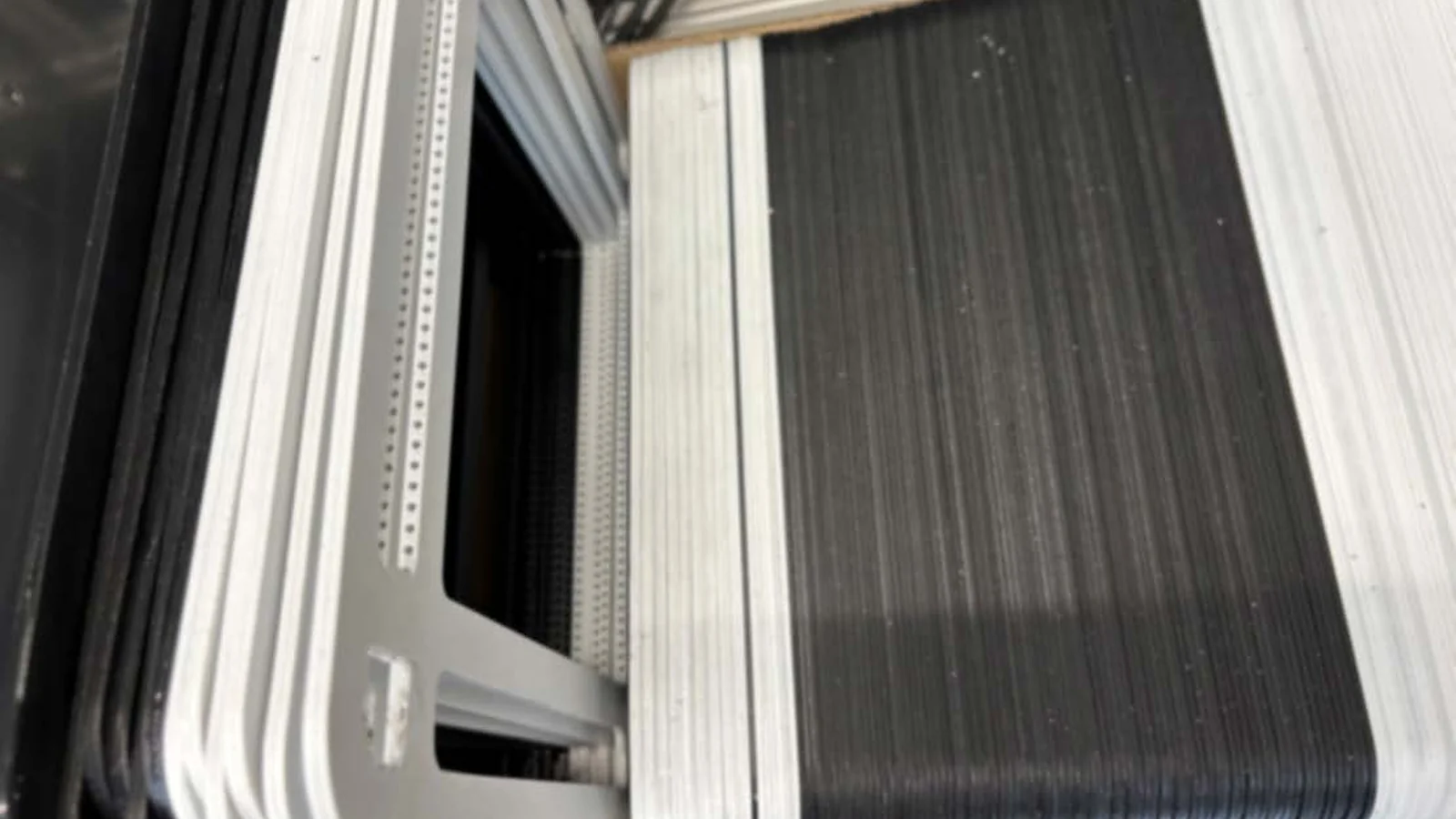
The large cell was designed at 408 cm²; for the tests its active area was restricted to 324 cm² to protect the membrane edges. It uses a flow-field-free, square design that removes costly machining and reduces offcut waste. For this first large-area test it combined our OXYGN™ and H2GN™ electrodes and AionFLX™ ionomer with a commercial benchmark membrane.
- 2 A/cm² at 2.07 V in 0.1 M KOH, within a few tens of millivolts of the 2 V target. At high current density the large cell did better than the small cells, although its series resistance was higher.
- Faradaic efficiency of 98.2–98.9 %, measured with a mass flow meter at 0.20–0.37 A/cm².
- About 110 hours of stable operation with only slight drift, despite two unplanned interruptions caused by the test rig.
Why this matters
Many AEM results never leave the 5 cm² scale. D3.1 is a public, partner-reviewed record that CRM-free, PFAS-free AEM materials can deliver around 2 A/cm² near 2 V in dilute electrolyte, and keep doing so at close to stack-relevant cell sizes. These results fed straight into HYScale's 6 kW short stack and the 100 kW system, described in our HYScale stack article.
Developing AEM cells or stacks? The materials used in D3.1 are available from us as OXYGN™ electrodes, H2GN™ electrodes, AionFLX™ ionomer and AionFLX™ membranes.
HYScale has received funding from the Clean Hydrogen Partnership and its members under grant agreement No 101112055.